
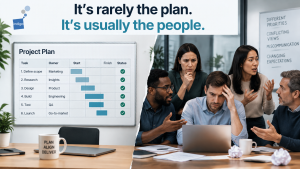
 Think about the last project that gave you a headache. Was it really the plan that went wrong? Or was it the manager who wasn’t told early enough, the team who heard about the change secondhand, or the person who signed off on it and then forgot what they’d agreed to?
More often than not, it’s what happens between the people involved.
What the numbers say
The Project Management Institute (PMI) found that ineffective communication was a contributing factor in more than half of unsuccessful projects. Its research also found that 56% of the money at risk on projects was attributable to ineffective communication. That’s a significant amount of money tied up in something that might seem like a straightforward part of project delivery.
It’s not just a problem for small or under-resourced projects, either. In Scotland, the Government’s Digital Assurance Office analysed 277 reviews of major digital projects carried out between 2017 and 2025. Communication and stakeholder engagement featured in nearly a third of the reports, despite accounting for just 4% of the recommendations. These projects were subject to formal assurance and review, yet the same challenges kept appearing.
And many projects are run by people without formal project management training. In a Planview study of 650 professionals involved in project work, two-thirds weren’t project management certified but were expected to manage projects. One in five described themselves as “accidental” project managers: people who find themselves taking responsibility for projects alongside their day job.
So whether you’re a qualified project manager or someone running a project from the side of your desk, the challenge is the same. Getting the work done is one thing. Getting the right project stakeholders involved, keeping them informed and maintaining their support is another.
Where it usually goes wrong
Stakeholder problems rarely announce themselves. They creep in.
Someone who should have been involved isn’t on anyone’s list, until they object in week eight. Updates go out when there’s time, which is usually not often enough. Expectations drift, so what the sponsor thinks they’re getting and what the team is building slowly move apart. Or everyone is keen at the kick-off, then hears nothing for two months and quietly loses interest.
On a large project, that might mean a formal review flags a problem. On a small one, it might mean a colleague who could have helped ends up blocking you instead. Either way, it costs time.
Why it keeps happening
Partly because talking to people doesn’t feel like progress. When the deadline is tight, the plan and the tasks feel more urgent than a conversation, so the conversation waits.
Partly because it’s easy to focus on the obvious names, like the sponsor and the people doing the work, and miss the ones who sit slightly further out but can still slow things down.
And partly because silence is easy to misread. If nobody’s complaining, it’s tempting to assume they’re on board. Often they just haven’t been asked.
One question worth asking
You don’t need a big process to make a difference. Start by asking the people your project affects one simple question:
“What would make this project a success for you?”
You’ll often get different answers from different people, and that’s the point. One person might care most about saving time, another about reducing risk, and another about making life easier for their team. Those differences matter because they can influence how people respond to the project.
It’s much easier to deal with those differences at the start than to discover them at the end, when you’re presenting the finished work to someone who expected something else.
Then keep talking to them. The support you build at the kick-off won’t last unless you keep people involved.
Getting better at it
Working with stakeholders is a skill, and like any skill it improves with practice. The difficulty is that most people only get to practise on real projects, where mistakes are expensive.
Our Stakeholder Engagement workshop gives you a safer place to learn. You’ll look at how to work out who matters to your project, what they care about and how to bring them with you. Then you’ll put your approach into practice in a realistic, AI-powered business simulation. You’ll interact with virtual stakeholders, respond to their concerns and see how your decisions affect their willingness to support the project.
It works for experienced project managers and for people who run projects alongside another role. You can join a public workshop with people from other organisations, or bring it in-house so your whole team shares the same approach.
Find out more about the Stakeholder Engagement workshop
Struggling to get new stakeholders on side? Read Stakeholders who don’t know you don’t like you (yet).
Need to keep people informed? Read Giving status updates people remember.
Sources: Project Management Institute (2013), Pulse of the Profession: The Essential Role of Communications; Scottish Government Digital Assurance Office analysis of 277 major digital project reviews, reported by FutureScot (2026); Planview (2018), Global Study of Project Collaboration.
Frequently asked questions
Who are project stakeholders?
Project stakeholders are anyone who affects your project or is affected by it. That includes obvious people such as the sponsor, the project team and the end users, but also managers, suppliers, other departments and anyone whose support or approval you need.
Why do projects struggle with stakeholders?
Usually because engaging them gets less attention than the plan, the budget or the deadline. Key people are identified too late, communication isn’t planned, expectations aren’t managed and engagement fades once the project is under way.
When should I start engaging stakeholders?
As early as possible, ideally before the plan is finalised. People are far more likely to support a project they’ve had the chance to shape, and early conversations help you spot concerns before they become problems.
How often should I communicate with project stakeholders?
It depends on the person and their role in the project. Some people need regular, detailed updates, while others just need to know about key decisions and milestones. Keep communication going for the whole project, not just at the start.
Can you learn stakeholder engagement?
Yes. It involves practical skills, such as identifying who matters, understanding their priorities and choosing how to involve them, which you can learn and practise. Training with a realistic simulation lets you try different approaches safely before using them on a real project.