

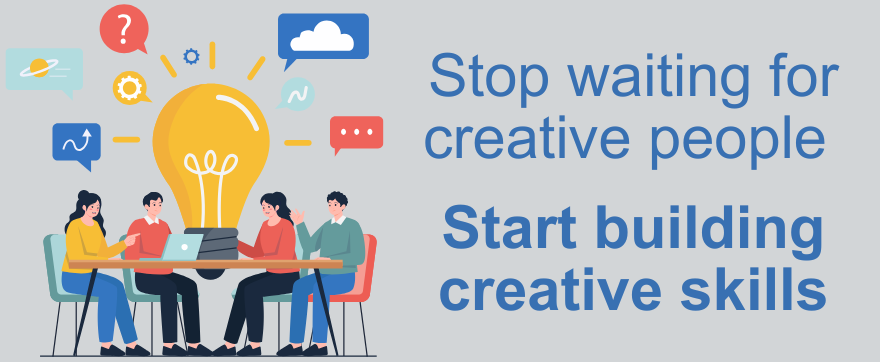
 Most businesses can tell you exactly who on the team is “creative”. It’s usually the same two or three people with everyone else being quietly opted out. That’s a problem, because demand for creative thinking isn’t holding steady while businesses wait for more naturally creative people to turn up. It’s becoming more important and most workplaces are still treating creativity as something you either have or you don’t, rather than something you build.
The gap between demand and supply
The World Economic Forum’s Future of Jobs Report 2023 found that employers expected the importance of creative thinking to grow faster than the importance of analytical thinking over the following five years, by 73%.
That’s not a minor shift in priorities. It’s businesses signalling that the ability to generate genuinely new ideas and approaches is becoming increasingly valuable, and that they expect that value to grow.
More recently, the Future of Jobs Report 2025 ranked creative thinking fourth among the core skills employers say their workforce needs most. The report also identifies creative thinking as one of the skills expected to continue increasing in importance through 2030.
Put those findings together and the picture is straightforward: businesses need more creative thinking, and they need to develop it across their existing workforce rather than relying on a small number of people who already identify as creative.
The problem isn’t necessarily a lack of creative potential. It’s a lack of creative thinking skills training.
Why “you either have it or you don’t” is the wrong question
Ask most managers how they’d increase analytical thinking in their team and you’ll probably get a plan: a course, a framework, a measurable skill or a development pathway.
Ask how they’d increase creative thinking and the answer is often less structured. It might mean hiring someone described as “creative”, running a brainstorming session or booking an away-day and putting some sticky notes on a wall.
That’s the actual problem. Businesses aren’t short of belief that creative thinking matters. They’re short of a process for building it in the people they already have.
Treating creativity as a fixed trait rather than a trainable skill doesn’t just under-serve the people who assume they’re “not creative”. It quietly caps the organisation’s creative output at whatever the two or three self-identified “creative ones” can produce. And if demand for creative thinking continues to rise, that’s not a particularly scalable strategy.
Creativity has a process. Most people have never been taught it.
The idea that some people are simply born creative and others aren’t doesn’t hold up particularly well against how creative work actually gets produced.
Professional creative work, in advertising, design, product development, strategy and innovation – rarely comes from waiting for inspiration. It comes from behaviours that can be deliberately practised: generating a high volume of raw ideas without judging them too early, looking at a problem from an unfamiliar angle, challenging assumptions, making connections between things that don’t initially appear connected, and pushing past the first, most obvious answer before committing to one.
Those behaviours can be developed.
Creative thinking skills training isn’t about turning analytical people into eccentric idea machines. It’s about giving people specific techniques that make different ways of thinking easier to reproduce.
The gap between the “creative” two or three people and everyone else is therefore not necessarily a gap in talent. It may simply be a gap in technique.
What effective creative thinking skills training looks like
If creativity is a skill, then training it should look like training any other business capability. That means more than explaining why creativity matters. People need to learn specific techniques, practise them and apply them to problems that actually matter to their work.
Effective creative thinking skills training should give people:
- Practical techniques: specific methods for generating alternatives, challenging assumptions and changing perspective.
- Deliberate practice: opportunities to use those techniques rather than simply hear about them.
- Real business application: practice against genuine problems, decisions and opportunities rather than abstract exercises alone.
- A separation between generation and evaluation: space to create possibilities before immediately judging them.
- A shared language: common techniques that teams can continue using after the training session ends.
That’s an important distinction. A brainstorming session can produce ideas without teaching anyone how to generate better ideas next time. An away-day can create energy without creating a repeatable capability.
Training should leave people with something they can use on Monday morning.
Lateral Thinking: generating better alternatives
This is what Lateral Thinking training exists to develop: specific, repeatable techniques for deliberately generating alternatives, challenging assumptions and disrupting the patterns that produce the same, safe, first idea every time.
The objective isn’t to make every idea brilliant. It’s to increase the number and range of possibilities available before the organisation decides what is worth pursuing.
That’s valuable because the first answer to a problem is often the most familiar one. It may be perfectly reasonable, but it may also be the answer everyone else in the market has already thought of.
Lateral Thinking gives people a structured way to move beyond that first answer.
Six Thinking Hats®: getting ideas examined and used
Generating ideas is only half the problem. The other half is what happens once a room full of people is looking at several of them. Without structure, creative discussions can collapse in one of two directions: the loudest or most senior voice picks a favourite early and the rest of the discussion quietly falls in line, or the group generates plenty of ideas and then struggles to examine them constructively, so nothing gets actioned.
This is where Six Thinking Hats® training complements Lateral Thinking. Six Thinking Hats® gives teams a shared structure for deliberately looking at a problem or idea from different perspectives – including facts, feelings, risks, benefits and possibilities – before deciding what to do next.
That matters because a good idea can fail for reasons that have nothing to do with its quality. It can be dismissed too early, dominated by one person’s perspective, or lost in an unstructured discussion.
Lateral Thinking helps generate more possibilities. Six Thinking Hats® helps teams examine those possibilities more deliberately. Neither is a substitute for the other.
Who should receive creative thinking training?
Not just the people already labelled as creative. In fact, those people may be the least urgent part of the training problem. They’re already producing ideas. The bigger opportunity is often the people who don’t think creative thinking is part of their role: analysts, project managers, engineers, finance teams, operational staff, leaders and subject-matter experts.
Creative thinking isn’t confined to creative departments. A finance team can generate alternative approaches to a budget problem. A product team can find different ways to solve a customer problem. A leadership team can challenge assumptions behind a strategic decision. An operations team can find a better way around a recurring constraint.
The point of organisation-wide creative thinking skills training isn’t to make everyone “creative” in the same way. It’s to give more people the ability to think differently when the situation requires it.
What this means for your future workforce plan
If creative thinking training isn’t already on your workforce plan, the WEF data is a reasonable prompt to put it there – not as a nice-to-have alongside technical upskilling, but as a skill with rising importance and, for many organisations, surprisingly little formal development behind it. And if it is already on the plan, it’s worth checking what “creativity training” actually means in practice.
- A brainstorming session isn’t a process.
- An away-day with sticky notes isn’t a technique.
- A presentation about innovation isn’t practice.
All three can feel productive without teaching anyone a repeatable way to generate, develop or examine ideas once the session ends. The organisations that close this gap first won’t necessarily be the ones with the most naturally creative hires. They’ll be the ones that stopped waiting for creativity to show up and started training it deliberately, structurally, and across the whole team rather than the usual two or three names.
The next step
Demand for creative thinking isn’t going to slow down to match the pace most businesses are training for it.
The gap closes fastest for organisations that treat creativity as a skill to build across the whole team, not a trait to go looking for in the next hire.
If your organisation wants to generate better alternatives, challenge assumptions more effectively and make more deliberate decisions about which ideas to pursue, structured creative thinking training can give your people the techniques to do it.
Get in touch to talk about bringing Lateral Thinking or Six Thinking Hats® to your team.
Frequently asked questions
Can creative thinking actually be trained, or are some people just naturally more creative?
It can be developed.
People may differ in their natural preferences, experiences and confidence, but creative thinking at work involves behaviours and techniques that can be practised. Generating alternatives without judging them too early, deliberately shifting perspective, challenging assumptions and pushing beyond the first answer are all trainable approaches.
Structured methods such as Lateral Thinking give people specific techniques for doing this consistently, rather than relying on occasional inspiration.
Why is demand for creative thinking growing faster than analytical thinking?
The World Economic Forum’s Future of Jobs Report 2023 found that employers expected the importance of creative thinking to grow faster than the importance of analytical thinking over the following five years – by 73%.
More broadly, as AI makes some forms of analysis faster and more accessible, the ability to generate genuinely new ideas, alternatives and approaches becomes comparatively more important.
That doesn’t make analytical thinking less valuable. It makes the combination of analytical and creative thinking increasingly useful.
What’s the difference between Lateral Thinking and Six Thinking Hats®?
Lateral Thinking focuses primarily on generating ideas and alternatives: deliberately disrupting habitual thinking patterns and moving beyond the first, most obvious answer.
Six Thinking Hats® provides a structure for examining a problem or idea from different perspectives, helping a group separate different modes of thinking rather than having everyone argue from their preferred perspective at the same time.
In simple terms: Lateral Thinking helps you generate more possibilities. Six Thinking Hats® helps you think through them more deliberately.
What should creative thinking skills training include?
Effective training should include practical techniques, guided practice and opportunities to apply those techniques to real work.
It should also give people a shared process and language they can continue using after the training ends. The goal isn’t simply to have a more creative workshop. It’s to build a capability that people can use when they’re facing a difficult problem, decision or opportunity.
Who benefits most from creative thinking training?
Creative thinking training can benefit people across an organisation, not just employees in traditionally creative roles.
Leadership, strategy, product, marketing, operations, finance, technology and project teams all face problems where generating alternatives or challenging established assumptions can improve the outcome.
The greatest organisational benefit often comes when creative thinking becomes a shared capability rather than something associated with a small group of “creative” employees.
How do we build creative thinking skills training into an existing L&D plan?
Treat it like any other trainable skill: use a structured programme with specific techniques, practice and a shared language that teams can continue using. Avoid relying on a single brainstorming workshop as the entire intervention. The aim should be to give people methods they can apply to real problems and decisions after the training is over.
Sources