

 The lockdowns are years behind us, but many of the habits they created are not. UK research suggests workplace communication has changed: we’re messaging more, speaking less and getting fewer opportunities to practise the live, unscripted conversations that are part of everyday working life.
“You’re on mute” has left the building. The habits haven’t.
In 2020, we switched almost overnight to chat threads, email and video calls. It was the right response at the time. But hybrid working has made many of those habits permanent. The CIPD’s Flexible and hybrid working practices in 2025 report found that 74% of UK organisations have hybrid working in place.
And people have noticed the change. In a survey of 1,000 UK workers by Perspectus Global for The Access Group, 91% agreed that hybrid working has changed how we talk to colleagues. More than half (54%) expected face-to-face communication to keep declining over the next five years.
Digital communication isn’t the problem in itself. Messages and emails are useful, particularly when people work across different locations. The problem is when they become the default, even when a conversation would be quicker, clearer or more effective.
We message the person sitting next to us
The most striking findings come from people who are back in the office. Research from Kahoot, reported by LBC, found that:
- More than one in five office workers go a whole working day without speaking to a colleague.
- More than half have messaged a co-worker in the same room rather than talking to them.
- Two in five (40%) feel lonely at work.
The pandemic didn’t just move work online. It helped make written, digital messages the default, and that default has followed people back to their desks.
Being in the office doesn’t automatically mean people are having more conversations. And the fewer opportunities people have for informal interaction, the less practice they get at the spontaneous conversations that keep working relationships moving.
Five everyday situations. Can you score 5/5?
The phone has become the scary option
Phone calls are a good test of thinking on your feet: no script, no edit button, no time to polish a reply. They’re also where the hangover shows particularly clearly.
In a March 2024 survey of 2,000 UK office workers by Face For Business, 65% said they had experienced some phone anxiety in the past year, while nearly two thirds (62%) had avoided answering a work call because of it. Younger workers were more likely to experience phone anxiety, although avoiding calls was common across age groups.
Outside work, Uswitch research found that around a quarter of 18 to 34-year-olds never answer their phone at all.
Some employers and colleges now run sessions to help people overcome phone anxiety and rebuild basic confidence.
It’s worth asking why people who communicate constantly through messaging apps can feel so uncomfortable picking up a phone. One possible explanation is simple: the less we practise something, the less confident we become doing it.
Why it matters to the business
This isn’t just about office etiquette. When workplace communication suffers and people become less confident in the moment, the consequences reach much further.
- Career opportunities can be missed. In 2023, Right Management research for ManpowerGroup found that 26% of hiring managers thought hybrid workers were less likely to be considered for promotion. A further 38% thought remote workers were less likely to spend time with senior managers.
- Problems take longer to resolve. When a two-minute conversation becomes a chain of emails, decisions can slow down and misunderstandings can multiply. A quick discussion can often resolve something that would otherwise take days of messages.
- People feel disconnected. Kahoot’s 2026 research found that half of office workers get less than an hour of face-to-face time with their manager each week.
These habits aren’t just a matter of communication preference. They affect how people work together, how quickly decisions get made and how confidently people contribute.
The encouraging part is that none of this is permanent. Speaking clearly and confidently, especially on the spot, is a skill, and skills that fade through lack of practice can be rebuilt.
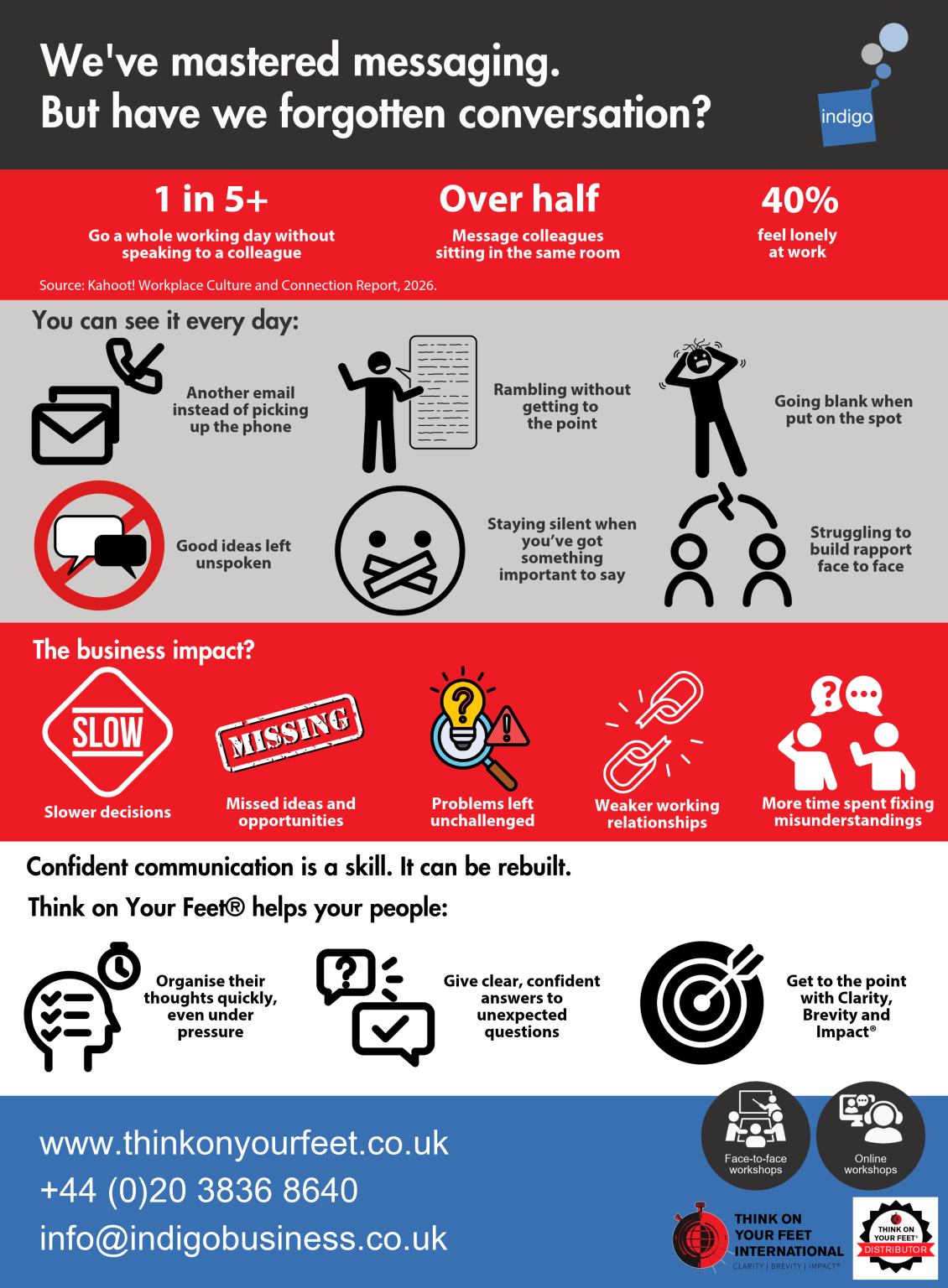 Here’s the Covid communication hangover at a glance: what the research shows, how it shows up every day, and what it’s costing organisations.
Want a copy to share with your team? Download the free infographic (PDF)
The skill we’ve lost: thinking on our feet
Most workplace communication doesn’t happen in a presentation or a carefully drafted email. It happens in the moments between them.
- Someone asks an unexpected question in a meeting.
- A colleague challenges your recommendation.
- Your manager wants a quick explanation of what’s happening.
- A customer calls with a problem you weren’t expecting.
These are the moments when you have seconds to understand what’s being asked, organise your thoughts and respond clearly. That’s what it means to think on your feet: communicating with Clarity, Brevity and Impact® without a script.
And like any skill, it needs practice. Digital communication has its place, but it can’t replace every conversation. The ability to think clearly and respond confidently in the moment still matters.
Every conversation is an opportunity to practise. But people also need the techniques and confidence to make those conversations count.
THE UK HOME OF THINK ON YOUR FEET®
Clarity, brevity & impact® under pressure
Explore the programme, see what it can do and read delegate reviews at thinkonyourfeet.co.uk.
Frequently asked questions
What is the Covid communication hangover?
It’s the lasting effect of pandemic-era habits on workplace communication. Messaging instead of speaking, fewer informal conversations and less practice at answering questions on the spot have left some people less confident in live, unscripted conversations.
Is hybrid working to blame for declining communication skills?
Not entirely. Hybrid working has changed the opportunities people have to communicate, but it isn’t inherently a problem. The bigger issue is when digital communication replaces conversations that would be more effective face to face or over the phone. Kahoot’s 2026 research shows these habits persist even among people who are back in the office.
Why should employers care about workplace communication skills?
Confident communication helps people share ideas, resolve problems, build relationships and make decisions. When people struggle to communicate in the moment, misunderstandings can grow, decisions can take longer and career opportunities may be missed.
Is phone anxiety really a workplace problem?
Yes. In a 2024 survey of 2,000 UK office workers, nearly two thirds said they had avoided answering a work call because of anxiety. This matters because phone conversations often require people to listen, think and respond without the opportunity to edit or rehearse their answers.
Can communication skills be rebuilt?
Absolutely. Speaking clearly and confidently on the spot is a skill, not a personality trait. With the right techniques and regular practice, people can become more confident and effective communicators. Think on Your Feet® helps people organise their thoughts and communicate with greater clarity, brevity and impact.
In Part 2, we look at who is feeling the communication hangover most, why some people find speaking on the spot harder than others, and how Think on Your Feet® helps people rebuild their confidence.
Sources
- CIPD, Flexible and hybrid working practices in 2025 (2025)
- Kahoot, workplace isolation research, reported by LBC (July 2026)
- Face For Business, Research: The problem of phone anxiety in the workplace (March 2024)
- Uswitch, Call me maybe (not): a quarter of young people never answer the phone (April 2024)
- Right Management, ManpowerGroup UK Hiring Forces and Employers Survey, reported by HRreview (March 2023)
- Perspectus Global for The Access Group, hybrid working and office communication survey